Robot vacuums are worth it in Canada if you have mostly hard floors and want daily control of pet hair, crumbs and the grit tracked in from outside. They are not a replacement for a real clean: they skip stairs, struggle on thick carpet and some dark rugs, cannot reach high-traffic corners well, and need weekly upkeep themselves.
Here is the part the glossy reviews leave out. A Canadian winter turns your front hall into a sand trap: road salt, grit and slush come in on every boot, every day, from November to April. A robot can keep up with the surface layer of that. What it cannot do is the deep work underneath — the salt film on the hardwood, the grit ground into the rug fibres, the baseboards and stairs. Buy the robot for maintenance. Just do not expect it to rescue a floor that has not had a proper clean since the first snowfall.
• Worth it: mostly hard floors, pets that shed, a household that wants floors kept tidy between real cleans.
• Not worth it: a house of stairs and thick carpet, lots of cords and clutter on the floor, or an expectation that it replaces a deep clean.
• Most models run their basic clean from a button with no Wi-Fi; scheduling and room maps usually need the app.
• Upkeep is weekly: one manufacturer's schedule is a filter clean once a week, twice a week with pets.
• Never let a robot vacuum mouse droppings — the Public Health Agency of Canada says not to vacuum them at all.
Are robot vacuums worth it for Canadian homes in winter?
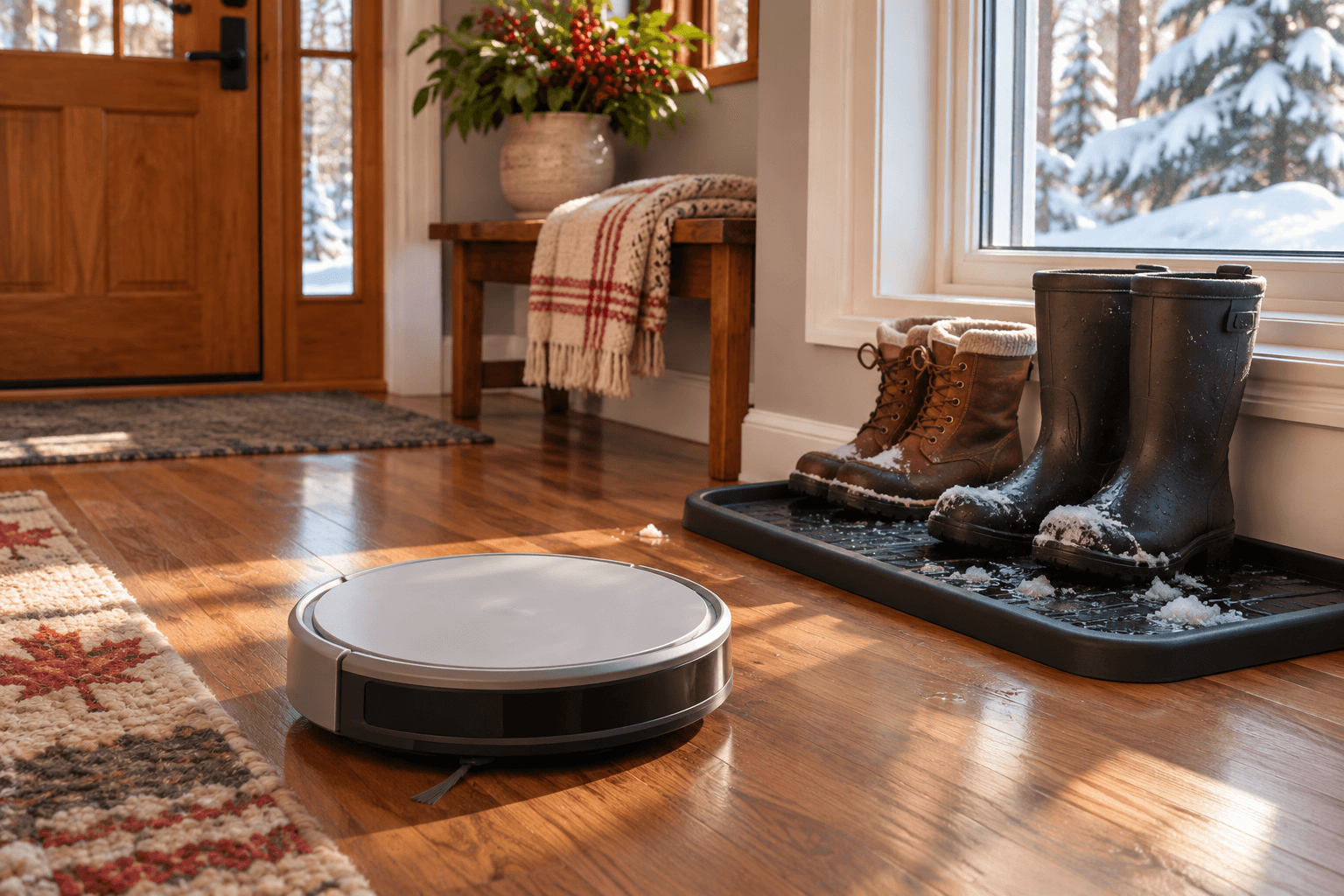
A robot vacuum earns its keep in a Canadian winter by running every day on the hard floors near the door, where grit and dried salt collect fastest. A daily pass stops loose grit from being walked through the rest of the house, which is the job a person with a broom never has time to do every single day.
The limits show up at the edges of that job. A robot picks up dry, loose debris. Wet slush, salt residue that has dried into a white film, and grit pressed into a rug are a different problem: they need a mop, the right cleaner and someone on their knees. Keep a boot tray and a washable mat at the door so the robot is cleaning up the last of the mess, not the whole of it.
Run the robot after the slush has dried, not while puddles are still on the floor. Most robot vacuums are built for dry debris, and pushing one through standing meltwater is how wheels, brushes and sensors get clogged with wet grit.
What does a robot vacuum do well, and what does it miss?
The table below sets out where a robot vacuum performs in a typical Canadian house and where a person still has to do the work.
Is a robot vacuum good for pet hair in Canada?
A robot vacuum is good for pet hair in Canada because the value comes from frequency, not power. A dog or cat that sheds heavily in the spring and fall leaves a fresh layer every day, and a robot that runs daily keeps that layer thin enough to manage. A weekly vacuum, however strong, lets hair drift under furniture and into corners first.
Pet homes pay for that in upkeep. In one major manufacturer's published maintenance schedule (iRobot, Roomba 100/1000 series), the filter and main brush are cleaned once a week, and twice a week in a home with pets. Hair wraps around the brush roll quickly, and a wrapped brush picks up far less.
If you find mouse droppings, keep the robot away from them. The Public Health Agency of Canada's hantavirus guidance says do not sweep or vacuum rodent droppings, because that releases particles into the air. Spray them with a disinfectant or a mix of 1 part bleach to 9 parts water, let the area soak for 10 minutes, then wipe up with paper towels or a wet mop.
Do robot vacuums work on carpet and area rugs?
Robot vacuums work on low-pile carpet and flat area rugs, and struggle on thick or shag carpet. Deep pile slows the robot, catches on its brushes and holds grit below where the suction reaches. If most of your house is wall-to-wall carpet, the robot becomes a surface tidier and the carpet still needs a full vacuum and a periodic professional clean.
Dark rugs are the second catch. Robot vacuums use downward-facing cliff sensors that bounce light off the floor to detect a drop. Roborock's own support pages explain that a dark carpet can absorb that light and trigger the cliff sensors the same way a drop does, so the robot refuses to clean it. If you own a black or very dark rug, check owner reviews of the specific model for that problem before you buy.
Rug tassels and fringes are the third. A robot that sucks up a fringe stops with its brush jammed. Fold fringes under or put the rug on the robot's no-go list in the app.
Do robot vacuums need Wi-Fi to work?
Most robot vacuums do not need Wi-Fi for a basic clean. Manufacturers including Eufy and Narwal state that pressing the clean button on the robot starts a cleaning run without the app or an internet connection. Some models still need the app once for first-time setup. What you lose without Wi-Fi is the convenience layer: schedules, room-by-room maps, no-go zones and running it while you are out.
No-go zones matter more than they sound. They are how you keep the robot off a dark rug, away from a pet bowl and out of a room full of charging cables, so if you plan to use the robot every day, plan to use the app.
What maintenance does a robot vacuum need?
A robot vacuum needs weekly cleaning and periodic part replacement, and skipping either is the most common reason owners decide the robot is not worth it. The schedule below comes from iRobot's published maintenance guide for its Roomba 100/1000 series; other brands publish similar schedules, so check the manual for your model.
In a Canadian winter, add one habit to that list: check the wheels and brushes for grit after any week of salted sidewalks. Fine grit is abrasive, and a robot that keeps dragging it across a hardwood floor is doing the opposite of its job.
When is a robot vacuum not worth it?
A robot vacuum is not worth it in a home where the floor is the obstacle course: charging cables, toys, socks and pet toys left out every day. The robot either stops, chews the obstacle or gets stuck, and someone has to pick up the floor before every run. If nobody in the house will do that, the robot ends up in a closet.
A robot vacuum is also not worth it if what you really need is a reset. A house that has gone a whole winter without a proper clean has salt film on the floors, grit in the rugs, dust on the baseboards and grime on the stairs. No robot touches any of that. Get the floors back to clean first, then let the robot hold the line.
• Count the stairs: the robot cleans one floor at a time and stops at every step.
• Look at your rugs: dark, shag or fringed rugs are the usual trouble spots.
• Walk the floor: if cords and clutter live there, the robot will find them first.
• Budget the upkeep: filters and brushes are consumables, replaced on a schedule.
• Plan the deep clean: the robot maintains a clean floor, it does not create one.
Should you book a deep clean before relying on a robot vacuum?
Book a deep clean first if the floors, baseboards and rugs have built up a winter's worth of salt and grit. A robot vacuum is designed to keep a clean floor clean; starting it on a floor full of embedded grit just pushes that grit around. One professional reset, then a daily robot pass, is the combination that works.
TaskRight is a verified, zero-commission home services platform in Canada. Post your cleaning job once — say it is a post-winter deep clean, list the rugs, stairs and baseboards you want done — and compare quotes from local cleaners. Every pro on TaskRight is verified by our team over the phone before they can quote. Pros keep 100% of what you pay and pay no per-lead fee, so nothing is priced back into your quote. Then let the robot keep it that way.
👉 Get quotes for the deep clean a robot can't do →
Robot vacuums in Canada: frequently asked questions
Are robot vacuums worth it in Canada?
Robot vacuums are worth it in Canada for homes with mostly hard floors, shedding pets and daily grit from winter boots. A robot keeps loose debris under control between real cleans. Robot vacuums are not worth it where stairs, thick carpet and floor clutter dominate, or where the floors need a deep clean the robot cannot do.
Is a robot vacuum good for pet hair?
A robot vacuum is good for pet hair because it runs every day, so shedding never builds up under furniture and into corners. Pet homes pay for that in upkeep: one manufacturer's schedule cleans the filter and main brush twice a week where pets live, because hair wraps around the brush and cuts pickup.
Do robot vacuums work on carpet?
Robot vacuums work on low-pile carpet and flat area rugs, and struggle on thick or shag carpet, where deep pile slows the robot and holds grit below the surface. Some dark rugs absorb the cliff-sensor light so the robot reads them as a drop and skips them. Wall-to-wall carpet still needs a full vacuum.
Do robot vacuums need Wi-Fi?
Most robot vacuums do not need Wi-Fi for a basic clean, because pressing the clean button on the robot starts a run without the app. Wi-Fi and the app are needed for schedules, room maps, no-go zones and remote starts, which are the features that keep a robot vacuum off dark rugs and away from cables.
Can a robot vacuum clean up mouse droppings?
No robot vacuum should clean up mouse droppings. The Public Health Agency of Canada says not to sweep or vacuum rodent droppings, because that releases particles into the air. Spray droppings with disinfectant or 1 part bleach to 9 parts water, let the area soak for 10 minutes, then wipe up with paper towels.
How often does a robot vacuum need maintenance?
A robot vacuum needs weekly maintenance. iRobot's schedule for its Roomba 100/1000 series cleans the filter and main brush once a week, or twice a week with pets, and replaces the filter every 3 to 6 months and the main brush every 6 to 12 months. Cliff sensors are cleaned once a month.
Last updated: November 2026. Maintenance intervals are taken from iRobot's published Roomba 100/1000 series maintenance guide and the hantavirus clean-up steps from the Public Health Agency of Canada (page details dated 29 July 2026). TaskRight does not test or rank robot vacuum models; check the manual for your own model.
Related reading:
Cleaning services in Toronto — post a deep-clean job once and compare quotes.
Laminate vs Vinyl Plank Flooring Cost in Canada — which hard floors stand up to winter grit.
Carpet Installation Cost in Canada — what carpet costs if the old one is beyond saving.
Cleaning pros in Canada — no lead fees.