
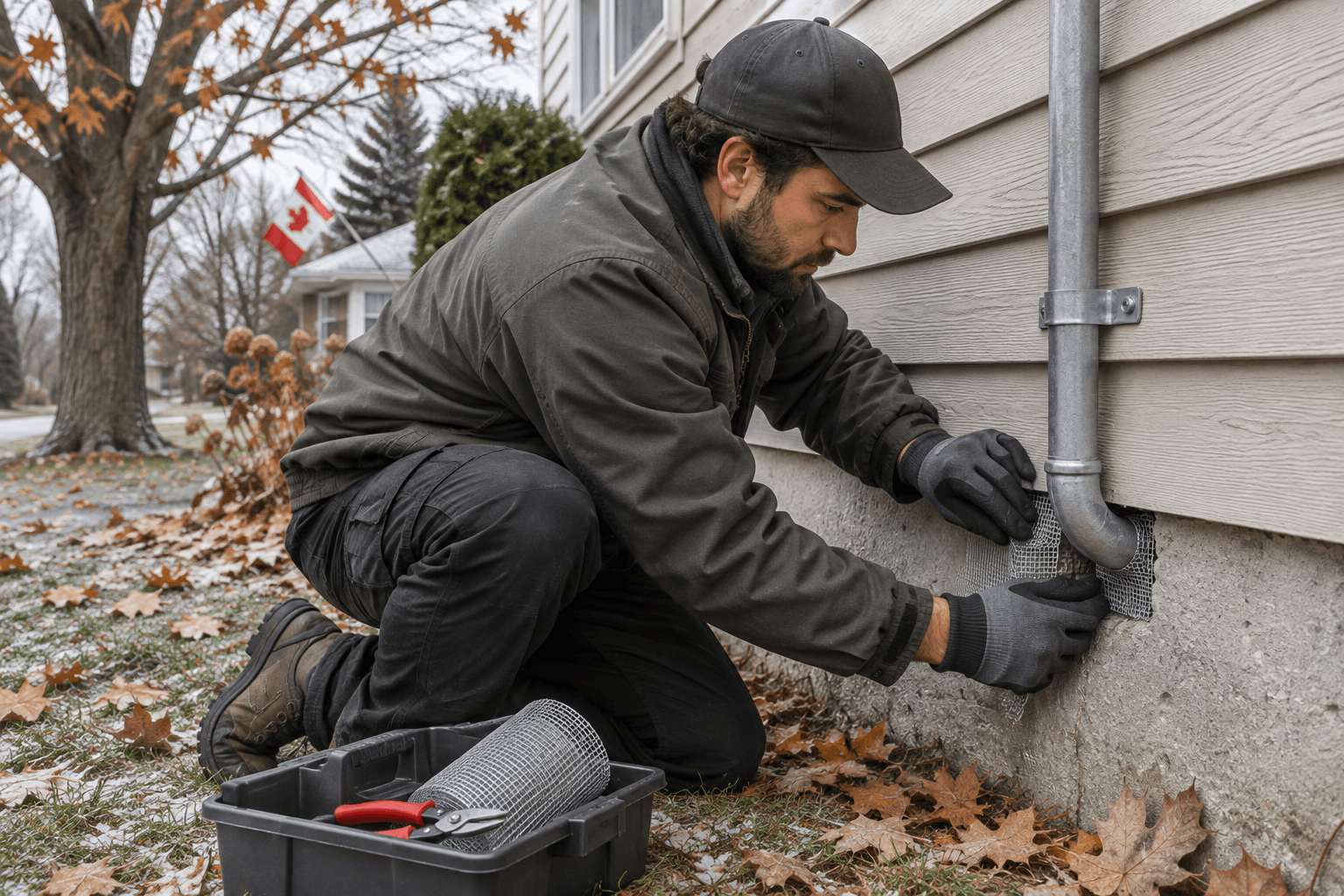
To get rid of mice in a Canadian home, seal every opening larger than 6 mm with metal or concrete, set snap traps along the walls about 1.8 m apart, and remove food and nesting material. Alberta's government recommends that combination. Clean droppings wet with disinfectant, never by sweeping or vacuuming, as public health officials advise.
Now the part that should make you act this week, not next month. Alberta's own figures say an indoor house mouse can breed year-round, with litters of about 5 to 6 young and up to 10 litters a year — and the young can breed themselves at 5 to 7 weeks. The one mouse you heard in the wall in November is not a mouse problem. By February it is a population. Every week you wait, the trapping job gets bigger and the cleanup gets worse.
• Seal first: every opening larger than 6 mm, with gnaw-resistant metal or concrete (Alberta).
• Trap second: snap or multi-catch traps along walls and runways, about 1.8 m apart (Alberta).
• Starve them: food in sealed containers, no pet food left out, clutter removed.
• Clean wet: never sweep or vacuum droppings — spray, soak 10 minutes, wipe (PHAC).
• Call a pro when you see mice in daylight, or when fresh droppings keep appearing despite trapping.
Why do mice get into Canadian homes in fall and winter?
Mice get into Canadian homes in fall and winter because the house offers the food, warmth and nesting material the outdoors stops providing. The Government of Alberta notes that mice normally stay within about 3 to 10 metres of their nest but range farther when food is scarce, which is exactly what a Canadian fall does to the yard.
Once inside, mice have what they need to breed through the winter. Alberta's mouse control guidance states that indoor house mice can breed year-round and may have up to 10 litters a year, with a gestation period of about 21 to 23 days. A house that stays warm all winter removes the seasonal pause.
How do you know if you have mice in your house?
The signs of mice in a house are droppings, gnaw marks, tracks or runways, damaged food and a stale odour where they feed. The Government of Alberta describes mouse droppings as averaging 4 to 7 mm long, concentrated in feeding areas. Look along baseboards, behind the stove and fridge, under sinks and in the back of cupboards.
• Mice seen during the daytime — Alberta says repeated daytime sightings can suggest a larger, established infestation.
• Fresh droppings in several rooms, not one cupboard.
• Gnawed wiring, insulation or food packaging.
• Shredded paper, fabric or insulation bundled into a nest.
• Scratching in walls or ceilings at night, every night.
The table below lists the signs of mice the Government of Alberta describes and what each one tells you about the size of the problem.
How do you mouse-proof a house in Canada?
Mouse-proofing a house in Canada means sealing every opening larger than 6 mm, because the Government of Alberta recommends exclusion of anything bigger than that (Alberta mouse control guidance). Use gnaw-resistant materials: Alberta names metal and concrete, and the Public Health Agency of Canada lists wire screening, steel wool, metal flashing and cement. Foam and caulk alone can be chewed through.
Work around the outside of the house first, then the inside. The checklist below covers the gaps that most often let mice into a Canadian home.
Seal before you trap, or at the same time. Trapping without sealing catches the mice you have and leaves the door open for the next ones.
What is the best way to trap mice in a Canadian home?
The best way to trap mice in a Canadian home is with snap traps or multi-catch traps placed along walls and known travel routes, about 1.8 metres apart, according to the Government of Alberta. Placement matters more than bait, because mice investigate new objects in their path. Put traps flush against the wall, where mice run, rather than in the open middle of a room.
- Use more traps than you think. One trap for a house is a gesture, not a plan.
- Check traps daily and wear gloves when you handle a caught mouse.
- Keep trapping after the catches stop. Breeding is year-round, so one quiet night is not the end.
- Poison is a last resort. Alberta says chemical control is generally used when infestations are well established or other methods are not enough, with bait stations protected from weather and non-target animals and label directions always followed.
Poisoned mice can die inside walls, where you cannot reach them, and bait left in the open is a hazard to children and pets. If you are at the point of considering poison, that is the point to bring in a licensed pest control technician.
How do you safely clean up after mice in Canada?
To safely clean up after mice in Canada, never sweep or vacuum droppings, because the Public Health Agency of Canada says that releases particles into the air. The agency's steps exist because rodent droppings can carry hantavirus. Follow them in order.
- Wear rubber or plastic gloves. In a confined space, PHAC advises an N95-level respirator.
- Spray droppings, nesting material and the surrounding area with a Health Canada-approved disinfectant, or a mix of 1 part bleach to 9 parts water.
- Let the area soak for 10 minutes.
- Wipe up the wet material with paper towels or a wet mop.
- Double-bag contaminated items, seal the bags and dispose of them according to local by-laws.
- Wash gloves in disinfectant and hot soapy water before taking them off, then wash your hands thoroughly.
PHAC also says that for heavily infested or contaminated areas, you should consider hiring a professional cleaning company. Heavy contamination includes attics full of nesting in the insulation and crawl spaces you cannot clean without lying in the droppings.
What keeps mice away from a house outside?
Mice stay away from a house when the yard gives them nowhere to live and nothing to eat near the walls. The Public Health Agency of Canada recommends moving woodpiles and compost bins away from buildings, and the Government of Alberta recommends mowing grass, clearing debris and securing garbage.
- Stack firewood away from the house walls, not against them.
- Move compost bins away from the foundation.
- Keep garbage and recycling in containers with tight lids.
- Bring pet food and bird seed inside, or store them in sealed metal containers.
- Cut back vegetation and clear debris along the foundation.
When should you call pest control for mice in Canada?
Call pest control for mice in Canada when you see mice during the day, find droppings in several rooms, hear activity in the walls or attic, or keep catching mice after sealing and trapping. Signs like these point to an established population and entry points you have not found. A technician finds and seals the gaps, sets a trapping plan and tells you whether insulation or wiring has been damaged.
We do not publish a mouse exterminator price. Every price we found in Canada comes from a pest control company, and we do not repeat a seller's figure as neutral. Ask each technician to quote the inspection, the exclusion work (sealing) and the follow-up visits as separate lines, so you can compare like with like.
TaskRight is a verified, zero-commission home services platform in Canada. Post your mouse problem once — where you see droppings, how long it has been going on, and whether you want exclusion work included — and compare quotes from local pest control pros. Every pro on TaskRight is verified by our team over the phone before they can quote. They keep 100% of every job and pay no per-lead fee, so there is no lead cost hiding in your quote.
👉 Get mice gone with a local pest control pro →
Getting rid of mice in Canada: frequently asked questions
How do I get rid of mice in my house permanently?
To get rid of mice in a Canadian house permanently, seal every opening larger than 6 mm with metal or concrete, trap along walls about 1.8 metres apart, and remove food and nesting material. The Government of Alberta recommends this approach. Trapping without sealing only removes the mice you have, so new mice keep arriving.
Why do I have mice in winter?
Mice come into Canadian homes in fall and winter for food, warmth and nesting material. The Government of Alberta says mice range farther from their nests when food is scarce, and that indoor house mice can breed year-round, with up to 10 litters a year. A warm house removes the winter pause in breeding.
How do you clean up mouse droppings safely?
Clean up mouse droppings safely by never sweeping or vacuuming them. The Public Health Agency of Canada says to wear gloves, spray droppings with disinfectant or 1 part bleach to 9 parts water, let the area soak for 10 minutes, then wipe up with paper towels or a wet mop and double-bag the waste.
What size hole can a mouse get through?
Mice can get through very small openings, and the Government of Alberta recommends sealing all openings larger than 6 mm to keep them out. Use gnaw-resistant materials such as metal or concrete. The Public Health Agency of Canada lists wire screening, steel wool, metal flashing and cement for sealing holes that rodents use.
What keeps mice away from a house in Canada?
Mice stay away from a Canadian house when there is nothing to eat or hide in near the walls. The Public Health Agency of Canada recommends moving woodpiles and compost bins away from buildings, and the Government of Alberta recommends mowing grass, clearing debris, securing garbage and storing food in sealed containers.
When should I call an exterminator for mice?
Call an exterminator for mice in Canada when you see mice during the day, find droppings in several rooms, hear activity in walls or the attic, or keep catching mice after you have sealed and trapped. The Government of Alberta says repeated daytime sightings can suggest a larger, established infestation.
Last updated: November 2026. Biology, exclusion and trapping guidance is from the Government of Alberta's mouse control page; clean-up steps are from the Public Health Agency of Canada's hantavirus prevention page (page details dated 29 July 2026). Both checked 8 November 2026.
Related reading:
Attic Insulation Cost in Canada — if mice have nested in the insulation.
Home Inspection Cost in Canada — what an inspector checks before you buy.
Pest control pros in Canada — zero commission.