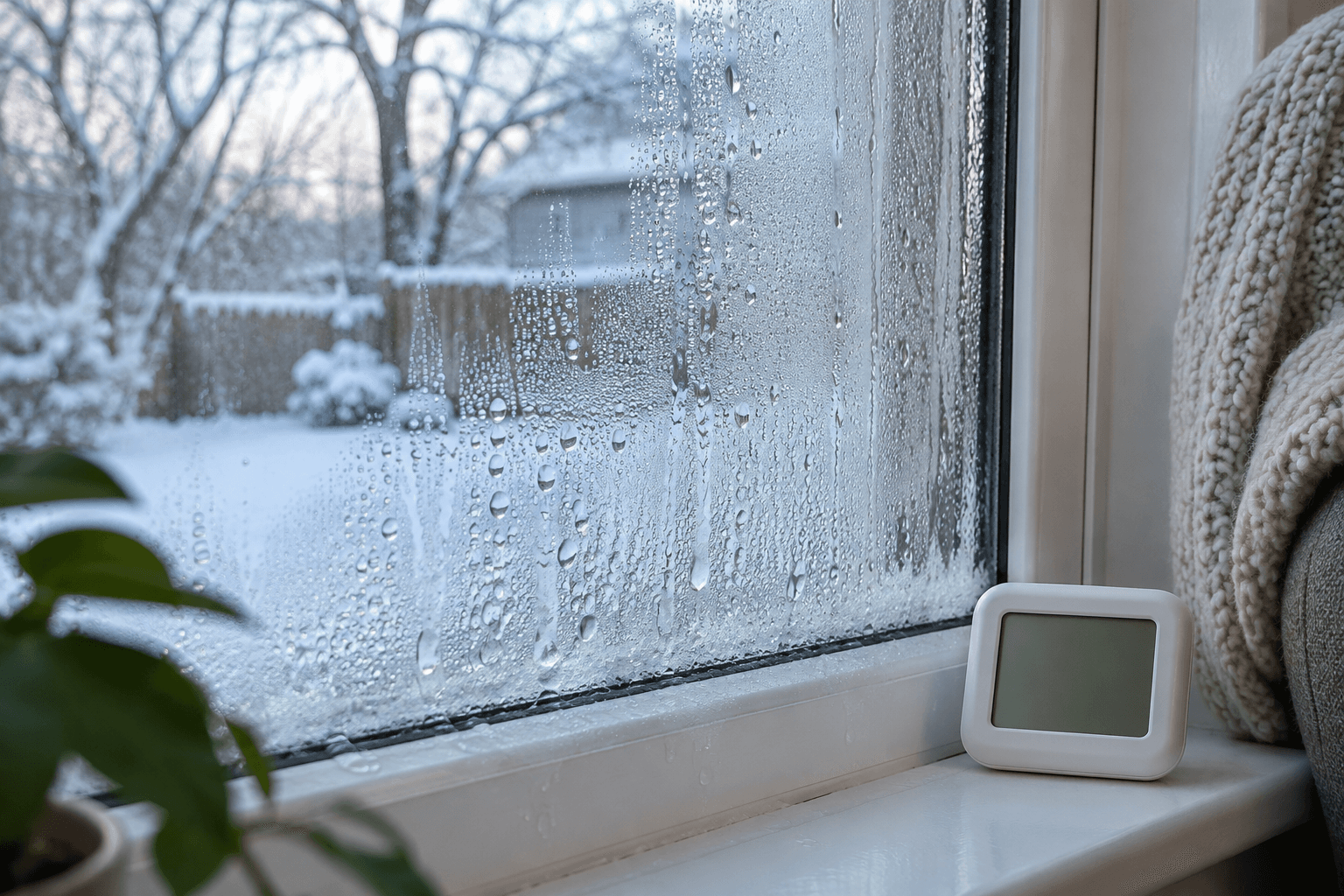
Condensation on the inside of windows in a Canadian winter means indoor humidity is too high for the outdoor temperature. Natural Resources Canada's table puts the limit for standard double-glazed windows at 34% relative humidity when it is -20°C outside, and 25% at -30°C. Lower the humidity or add ventilation, and the condensation stops.
Many of the pages ranking for this search are written by window sellers, and they end the same way: replace your windows. Sometimes that is right. Often it is the most expensive answer to a problem a hygrometer would have diagnosed. Water on the glass is a symptom. The cause is moisture in the air, from showers, cooking, laundry, people breathing and sometimes a furnace humidifier set for October in the middle of January. Leave it, and the water runs down onto the sill, soaks the frame and grows mould. Fix the humidity, and the same windows stay dry.
• Window condensation is a humidity problem first, not a window problem.
• NRCan's guide: keep humidity between 30% and 50%, lower in winter.
• Standard double-glazed windows stay clear up to 44% RH at -10°C, 34% at -20°C and 25% at -30°C outside.
• Measure with a hygrometer, which Health Canada calls an inexpensive tool sold at most hardware stores.
• Run kitchen and bathroom fans, vent the dryer outdoors, and turn down any humidifier.
• Occasional condensation is not a problem. Excessive condensation or frost means reduce moisture or increase ventilation.
Why do windows get condensation on the inside in winter in Canada?
Windows in Canadian homes get condensation on the inside in winter because the glass is the coldest surface in the room. When warm, moist indoor air touches it, the air cools below its dew point and drops its water on the glass. The colder it gets outside, the colder the glass, and the less humidity it takes to fog it.
Outdoor temperature is why the same house can have dry windows in November and dripping windows in January without anything changing indoors. Natural Resources Canada's Keeping the Heat In guide lists "frosting and fogging of windows" as a sign of higher humidity levels, and uses window condensation as its typical example of water vapour condensing on a cold surface.
What indoor humidity stops window condensation in a Canadian winter?
The table below reproduces Natural Resources Canada's Keeping the Heat In guide Table 9-1: the maximum indoor relative humidity at 21°C (70°F) before condensation forms on each window type, by outdoor temperature.
Read your row by the coldest night of the week, not the average day. A Toronto or Ottawa home with standard double-glazed windows that sits at 45% humidity will fog the first night the temperature drops toward -10°C. The same house held at 34% or lower stays clear down to -20°C.
The guide also offers a simpler test: "let your windows become your indicator." If excessive condensation appears on the inside of double-glazed windows, apart from those in the kitchen and bathroom, "you have too much moisture in the air."
Is window condensation a sign you need new windows in Canada?
Window condensation alone is not a sign a Canadian home needs new windows. Table 9-1 shows the real trade-off: at -20°C outside, standard double glazing fogs above 34% humidity while triple-glazed low-E holds out to 67%. Better glass raises the limit, but it does not remove the moisture.
Replacing windows is a decision about comfort, drafts and energy. Make it on those grounds. If the only complaint is condensation, measure and lower the humidity first. The humidity test costs a hygrometer and a few weeks of attention, and it tells you whether the windows are the problem at all.
How do you stop condensation on the inside of windows in Canada?
To stop condensation on the inside of windows in a Canadian home, reduce the moisture you produce and remove the moisture you cannot avoid. Health Canada and Natural Resources Canada's Keeping the Heat In guide give these steps:
- Measure first. Put a hygrometer in the main living area and a bedroom.
- Turn down or switch off any humidifier until readings sit under the Table 9-1 limit for that week's cold.
- Run kitchen and bathroom fans while cooking or showering, and let them run for a few minutes after (Health Canada).
- Vent the clothes dryer, stove, kitchen and bathroom fans to the outdoors. Avoid range hoods that recirculate air back into the room (NRCan).
- Put the bathroom fan on a timer or humidity controller so it runs long enough without anyone remembering (NRCan).
- Keep blinds and curtains slightly open at night so room air reaches the glass.
- Do not let heavy curtains or blinds seal off the glass. Health Canada notes they "can trap the cold and moisture and cause condensation on your windows."
- Use a dehumidifier if humidity stays high (Health Canada).
If the windows still sweat with fans running and the humidifier off, the house is not exchanging enough air. A house that sweats with fans running has a ventilation problem, and the fix is mechanical.
Does a heat recovery ventilator stop window condensation in a Canadian home?
A heat recovery ventilator (HRV) is the mechanical fix for a Canadian home that holds too much moisture. Natural Resources Canada's Keeping the Heat In guide describes it as a balanced system where exhausted air is replaced with a dedicated supply of incoming air, and notes an HRV "typically recovers 70 to 80 percent of the heat from the exhaust air."
The guide is clear that "HRVs and ERVs must be installed, balanced and commissioned properly by a certified technician", and that central ventilation systems should be designed, specified and installed by a professional. Once running, routine maintenance is cleaning the filters and the core, which a homeowner can do.
When does window condensation become a mould problem in Canada?
Window condensation becomes a mould problem in a Canadian home when water sits on sills and frames day after day. Health Canada sizes mould by area, and the table below shows its three categories.
Dry the frame, clean small patches, and fix the humidity the same week. Mould on a window frame comes back every winter until the moisture source is fixed. For extensive mould, Health Canada advises considering professional help.
Should you turn off the furnace humidifier when windows sweat?
Turn a furnace humidifier down, or off, whenever Canadian windows start to sweat, because a humidifier is adding exactly the moisture the glass is rejecting. Set it against the Table 9-1 limit for the coldest temperature forecast that week, and lower it again as the weather drops.
A humidifier and dry winter air are not enemies. Natural Resources Canada's Keeping the Heat In guide notes that humidity above 20% helps prevent dry, sore throats, so the target is the band between dry air and wet windows.
TaskRight is a verified, zero-commission home services platform in Canada. If your windows sweat even with the fans running, post your ventilation or HVAC job once and compare quotes for an HRV, a humidifier fix or a ventilation check from local HVAC pros. Every pro on TaskRight is verified by our team over the phone before they can quote. They keep 100% of every job and pay no per-lead fee, so nothing is priced back into your number.
👉 Get a local HVAC pro to fix your ventilation →
Frequently asked questions about window condensation in Canada
Why is there condensation on the inside of my windows in winter in Canada?
Condensation forms on the inside of windows in a Canadian winter because indoor humidity is too high for the outdoor temperature. The glass is the coldest surface in the room, so moist air drops its water there. Natural Resources Canada puts the limit for standard double-glazed windows at 34% humidity when it is -20°C outside.
What humidity should a Canadian house be in winter to avoid window condensation?
A Canadian house should keep humidity between 30% and 50%, lower in winter, according to Natural Resources Canada. For standard double-glazed windows, its table sets the maximum at 44% when it is -10°C outside, 34% at -20°C and 25% at -30°C, measured at an indoor temperature of 21°C.
How do I stop condensation on my windows in winter?
To stop window condensation in a Canadian winter, measure humidity with a hygrometer, turn down any humidifier, run kitchen and bathroom fans and let them run a few minutes after use, and vent the dryer outdoors. If windows still sweat, a heat recovery ventilator installed by a certified technician adds balanced ventilation.
Is window condensation a sign I need new windows in Canada?
Window condensation alone is not a sign a Canadian home needs new windows. Better glass tolerates more humidity: at -20°C outside, standard double glazing fogs above 34% humidity while triple-glazed low-E holds to 67%, per Natural Resources Canada. Lower the indoor humidity first and see whether the condensation stops.
Can window condensation cause mould in a Canadian home?
Yes. Window condensation that sits on sills and frames day after day can grow mould in a Canadian home. Health Canada classes 1 to 3 patches under 1 square metre each as small, and a single patch larger than 3 square metres as extensive, for which Health Canada advises considering professional help. Fix the humidity to stop it returning.
Last updated: November 2026. Humidity limits are taken from Table 9-1 of Natural Resources Canada's Keeping the Heat In guide, along with its ventilation and HRV guidance. Ventilation steps, hygrometer advice and mould size categories are taken from Health Canada's page on reducing humidity, moisture and mould (February 13, 2023).
Related reading:
Attic Insulation Cost in Canada: Price After Rebates — stop the heat loss that chills surfaces.
Duct Cleaning Cost in Canada — what a duct cleaning includes and costs.
Heating, cooling and HVAC pros in Canada — post your job with no lead fees.