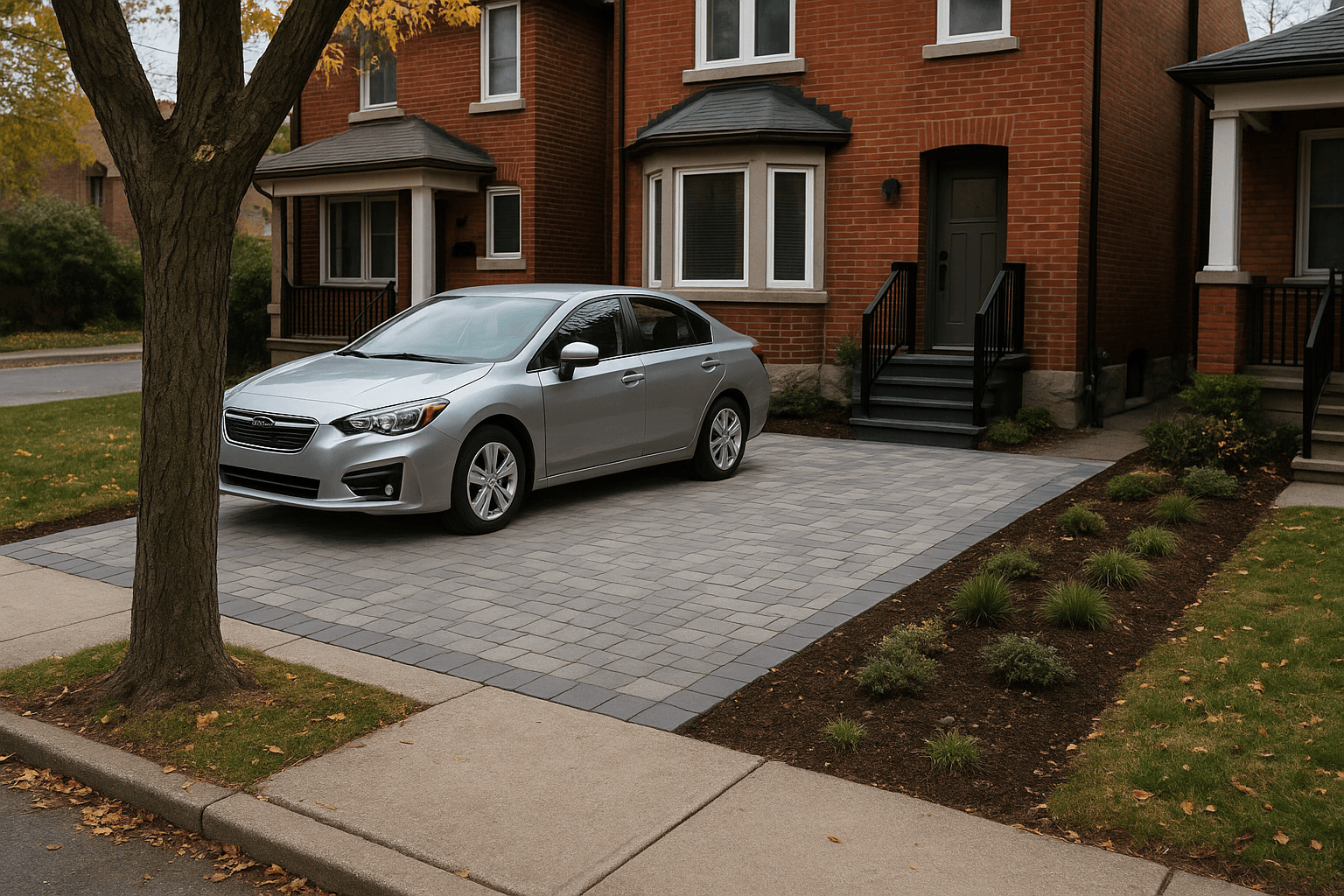
A front yard parking pad in Toronto needs a City licence, not a building permit, because you are renting part of the City boulevard to park on. A new application costs from CAD 514.41 plus HST under the 2026 fee schedule. The licence does not travel with the house — a new owner has to apply to have it transferred.
The transfer rule is the one that costs people money, and it usually surfaces at the worst moment. The City puts it in writing: "the license does not follow the property, but that a new property owner will need to apply to have the license agreement transferred." So the pad you paid a premium for at closing can be an unlicensed pad the morning you get the keys — and an unlicensed pad is not a paperwork problem, it is a paved surface the City can make you remove. Nobody discovers this while the concrete is being poured. They discover it when the next buyer's lawyer asks.
• A front yard pad is a licence to rent City boulevard, not a building permit.
• New application: from CAD 514.41 plus HST on the City's 2026 fee schedule.
• The licence is not automatic on sale — the buyer must apply for a transfer.
• Disabled front yard parking licences are not transferable to a new owner at all.
• The City charges a separate inspection fee for unlicensed pads.
• You may not push snow from your pad onto the public sidewalk or road.
Do you need a permit for a front yard parking pad in Toronto?
You need a licence. Toronto's own wording is specific: "An off-street parking permit is required if property owners wish to rent part of the City boulevard to supplement space on private property for parking."
Every word of that sentence is doing work. Rent means this is an ongoing tenancy with an annual fee, not a one-time approval you pass and forget. Part of the City boulevard means the strip you think of as your front garden is, in part, municipal land. And supplement space on private property means the pad is treated as an extension of your parking, not a right that comes with owning the house.
Why is a Toronto parking pad a licence and not a building permit?
Because of who owns the ground. A building permit is permission to build something on your land. A front yard parking licence is permission to occupy and use the City's land, which is why it renews annually and why it can be refused, transferred or lost in a way a building permit cannot.
The practical consequence is that passing an inspection does not end the relationship. You hold a licence that has to be kept current, and the obligation is continuous. Toronto attaches conditions to it too, including one people break every winter without thinking: "clearing snow or ice from private property and/or any licensed area onto public sidewalks or roadways is not permitted."
How much does a front yard parking pad licence cost in Toronto?
A new application starts from CAD 514.41 plus HST on the City of Toronto's 2026 fee schedule for residential off-street front yard and boulevard parking. The 514.41 covers the application itself, and it is the figure to budget from before any paving is quoted.
The application fee is separate from the annual charge for renting the boulevard, which the City bills every year, and separate again from construction costs, a paving permit and any ramp or curb work. Toronto publishes a full schedule of these charges and revises it annually. Confirm the current amounts with the City's Off Street Parking office before you commit, rather than working from a figure quoted on a blog — including the ones circulating from the 2025 schedule, which the 2026 fees have superseded.
What happens to a Toronto parking pad licence when you sell the house?
Nothing automatic, and that is the point. The City states that the licence "does not follow the property" and that "a new property owner will need to apply to have the license agreement transferred". A transfer is its own application with its own fee.
One category cannot be transferred at all. Toronto notes that "disabled front yard parking licenses are not transferable to a new property owner". If the pad you are buying is licensed on that basis, it does not carry over to you in any form, and the City directs you to the relevant district office to find out where that leaves the property.
How do you check whether an existing Toronto parking pad is licensed?
Do it before you buy, not after. The City advises that "before you buy a property you may wish to ensure that any existing front yard parking facility is properly licensed", and publishes a Street-Index listing the locations licensed for residential off-street parking.
For a transaction you can go further and request written confirmation. Toronto will issue "an official letter with property information, which may be required to complement an offer of purchase and sale", requested in writing, and a fee applies. Confirm the current amount with the Off Street Parking office when you request it.
What does Toronto charge if your parking pad is unlicensed?
The City's fee schedule carries a dedicated line item for an inspection fee for unlicensed pads, which tells you how routinely this comes up. An unlicensed pad is not simply a pad awaiting paperwork — it is an unauthorised occupation of City boulevard, and the City is not obliged to licence it after the fact.
The asymmetry is worth understanding before anyone pours concrete. Getting the licence first is an application. Getting it afterwards is an application you might lose, on a surface you have already paid to build.
Which Toronto properties cannot get a front yard parking pad?
Availability is not uniform across the city, and eligibility is decided by the City rather than by your contractor or your lot. Whether a given address can be licensed at all depends on local restrictions, the geometry of the boulevard and existing City infrastructure such as street trees, poles and hydrants.
The City directs address-specific questions to the Off Street Parking office, and that is genuinely the only reliable answer: "If you have any questions about a particular address, please contact the Off Street Parking office." Treat any quote given without that confirmation as a quote for a pad that may never be licensed. If a City street tree sits in the boulevard you are proposing to pave, there is a second by-law in play — see our guide to Toronto tree removal permits, where street trees are protected at any size.
What are the 2026 payment deadlines for a Toronto parking pad?
Two operational facts matter right now if you already hold a licence. The City states that "the online payment option is now closed for the 2026 Street Allowance Rental" and that it "will be available in February/March 2027".
More importantly for anyone with an unpaid balance: "All outstanding 2026 annual fee invoices have been transferred to the taxes section." An unpaid boulevard rental does not simply sit as a late invoice — it moves onto the property tax account. Toronto asks that you contact 311 about outstanding 2026 invoices.
Who should build a Toronto parking pad once the licence is issued?
A licensed pad has to be built to the dimensions and surface the City approved, which makes this a job for a paving or concrete contractor who has read the approval rather than a general crew working from a sketch. Get the licence conditions in front of whoever quotes, and have the quote reference them.
Ask who is responsible if the finished pad does not match the approved drawing, and get the answer in writing. Rebuilding a non-conforming pad on City land is not a snag-list item. Rebuilding means the whole surface again.
TaskRight is a verified, zero-commission home services platform in Canada. Post your Toronto parking pad job once — say whether the licence is already issued, transferring, or still to be applied for — and read the quotes that come back priced against the City's approved dimensions rather than a guess. RightPro-verified pros keep 100% of every job and pay no per-lead fee, so nothing is priced back into your number.
👉 Get paving quotes built to the approved licence →
Frequently asked questions about front yard parking pads in Toronto
Do you need a permit for a front yard parking pad in Toronto?
You need a City of Toronto licence rather than a building permit. The City requires an off-street parking permit where an owner wishes to rent part of the City boulevard to supplement parking space on private property, and it carries an annual fee because you are renting municipal land.
How much does a front yard parking pad licence cost in Toronto?
A new application starts from CAD 514.41 plus HST under the City of Toronto's 2026 fee schedule for residential off-street front yard and boulevard parking. Annual boulevard rental, paving and ramp charges are billed separately, and Toronto revises the schedule each year.
Does a Toronto parking pad licence transfer when the house is sold?
No. The City states that the licence does not follow the property and that a new owner must apply to have the licence agreement transferred, which is a separate application with its own fee. Disabled front yard parking licences cannot be transferred to a new owner at all.
How do I check if a Toronto front yard parking pad is legal?
Toronto publishes a Street-Index of locations licensed for residential off-street parking, and advises buyers to confirm that an existing front yard parking facility is properly licensed before purchase. For a transaction you can request an official letter with property information in writing, for a fee.
What happens if a Toronto parking pad is unlicensed?
An unlicensed pad is an unauthorised occupation of City boulevard rather than a paperwork gap, and the City's fee schedule includes a specific inspection fee for unlicensed pads. Toronto is not obliged to licence a pad after it has been built, so the surface can have to come up.
Can I shovel snow from my Toronto parking pad onto the road?
No. Toronto states that clearing snow or ice from private property or any licensed area onto public sidewalks or roadways is not permitted. The condition applies to the licensed boulevard area of a front yard parking pad as well as to the rest of your property.
Last updated: September 2026. The rules and figures on this page are taken from the City of Toronto's Residential Off-Street Front Yard & Boulevard Parking page, retrieved 14 September 2026 (City page last modified 11 August 2026), and reflect the City's 2026 fee schedule. Toronto revises these fees annually, and we re-check the page every six months.
Related reading:
Do You Need a Permit to Remove a Tree in Toronto? — City street trees in the boulevard are protected at any size.
Landscaping and outdoor pros in Canada — soft landscaping is part of what the City approves.
Renovation contractors in Toronto — post your job with no lead fees.