You need a City of Toronto permit to remove or injure a tree on private property measuring 30 centimetres or more in diameter at breast height, and a City-owned street tree of any size at all. A tree that is 100 per cent dead needs no permit. Nuisance — leaves, fruit, shade — is not an accepted reason.
Here is the part that decides who you should let near the tree. The by-law does not bind your arborist. The by-law binds you, the property owner, and keeps binding you after the truck leaves. The City writes that property owners "are responsible for protecting and providing regular maintenance to trees on their property and must follow the Tree Protection By-law". So when a crew quotes you a cheap same-week removal and tells you nobody checks a backyard, what you are actually buying is the contravention, the replanting order and the neighbour who photographs the stump. The cut takes an afternoon. A protected tree cannot be un-cut.
• Private tree, 30 cm diameter or more at breast height: permit required to remove or injure it.
• Street tree: any size. There is no minimum diameter for a City-owned tree.
• 100 per cent dead: no permit. Hazardous or terminally diseased: you still need a written permit exception first.
• Multi-stem tree: if one stem reaches 30 cm, the whole tree is protected.
• Removal permits come with a replanting condition. No room to replant means cash-in-lieu of CAD 583 per tree.
Do you need a permit to remove a tree in Toronto?
In Toronto you need a permit to remove or injure a private tree of 30 centimetres diameter or more, and a City-owned street tree of any size. The City states it plainly: "Any activity that can cause a tree of 30 centimetres or more in diameter, to be injured or removed, on private property, is prohibited unless authorized with a permit under the Tree Protection By-law."
Read the word injure carefully, because it is the one that catches people. The by-law is not only about felling a tree. Heavy pruning, cutting roots for a trench, compacting soil over the root zone with a bobcat or stacking material against the trunk can all count as injuring a protected tree. A Toronto homeowner who never intended to remove anything can still need a permit because of where the excavator parked.
Which trees does Toronto's Tree Protection By-law actually protect?
Toronto protects four different categories of tree under different instruments, and they do not share one threshold. The table below is the whole map, and it is the reason a single "is my tree protected?" answer is usually wrong.
| Where the tree is | Size that triggers a permit |
|---|---|
| On private property | 30 cm diameter at breast height or more |
| City-owned street tree | Any size |
| In a City park | Any size, under the Parks By-law |
| In a ravine or natural feature area | Any size, under the Ravine and Natural Feature Protection By-law |
One more category catches people late in a project. Any tree you plant as a condition of a Toronto tree permit is protected "from the time they are planted, regardless of size". The sapling the City made you put in is not a sapling in by-law terms. The City counts it as a protected tree on day one.
How do you measure whether your tree is 30 centimetres in diameter?
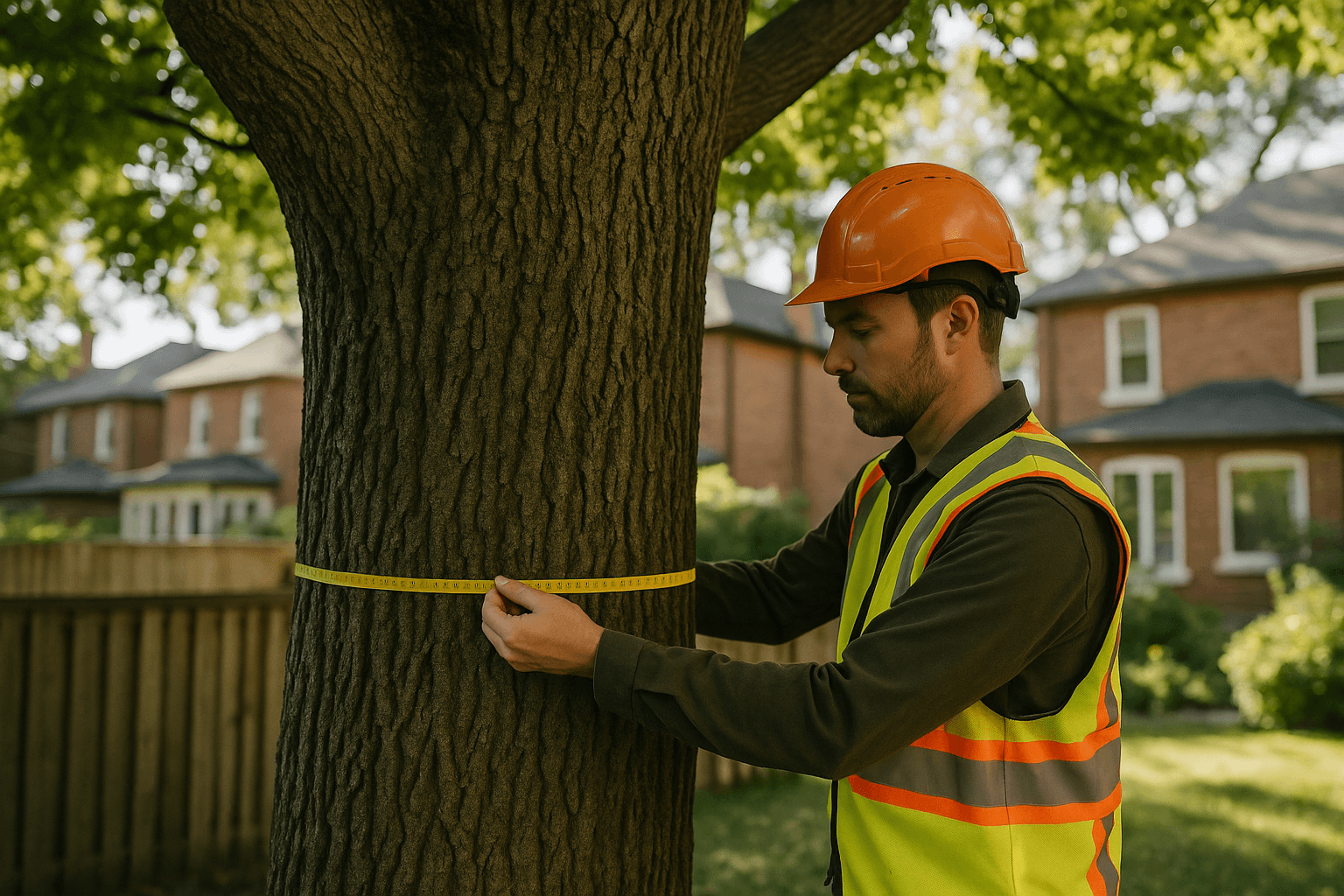
Toronto measures diameter at breast height, 1.4 metres above the ground, and the City publishes the arithmetic rather than asking you to eyeball it. Put a tape around the trunk at that height to get the circumference in centimetres, then divide by 3.14. The result is the diameter at breast height. If it is 30 centimetres or more, the tree is protected.
If a tree has several stems, Toronto uses the largest stem to size it — and "where at least one stem measures 30 cm in diameter or greater, the tree (including all stems) is protected under the bylaw". A clump of six thin trunks with one thick one is a protected tree in its entirety, not five unprotected stems plus one protected one.
In practical terms 30 centimetres of diameter is about 94 centimetres of circumference. If your tape reads anywhere near that, treat the tree as protected and ask the City before anyone starts, because the measurement is the City's to confirm and not the crew's to estimate.
Why does a street tree in Toronto need a permit at any size?
A City-owned street tree belongs to Toronto, not to the homeowner whose lawn it stands beside, so there is no diameter threshold to fall under. The City writes that "any activity that can cause a street tree of any size to be harmed or removed is prohibited unless authorized with a permit".
The trap is that a street tree does not always look municipal. Toronto notes that street trees "may be located in the boulevard between the sidewalk and the road, or in a portion of a front yard next to the road or sidewalk". A tree standing well inside what you mow can still be the City's. If the tree is anywhere near the street line, confirm ownership before you get a quote, not after.
When can you remove a tree in Toronto without a permit?
There is exactly one clean case. The City states that "a permit is not required to remove a tree that is 100 per cent dead". Every other condition you might describe as dying, dangerous or diseased still goes through the City first.
The distinction is sharper than it sounds, and Toronto draws it explicitly: "A permit is still required for trees that are in poor condition." Poor condition is not dead. A tree that leafs out on one limb is not 100 per cent dead. If a contractor tells you the tree is "basically dead" and that is good enough, he is describing a standard the by-law does not contain.
What is a permit exception, and when does Toronto require one?
A permit exception is a written confirmation from the City that your situation falls outside the permit process. A written exception is not the same as needing nothing, and Toronto is direct about the sequence: "You must receive the permit exception confirmation from the City before proceeding with removal or injury of a tree, unless immediate tree work is required to eliminate a dangerous situation."
Two situations need one. An imminently hazardous tree, which the City describes as "destabilized or structurally compromised that poses an imminent danger to life or the property", where the owner arranges removal. And a terminally diseased tree that is "no longer maintainable" — noting that, as the City puts it, "not all diseases will cause a tree to die". If Toronto decides the tree does not qualify for an exception, you can still apply for a permit.
Which reasons will Toronto refuse as grounds to remove a tree?
The City is blunt about the purpose: "The City's Tree By-law prevents the unnecessary removal of trees to protect and retain healthy trees." Nuisance arguments, it adds, are "generally not supported as reasons to remove or harm a tree". Leaf drop, fruit, shade and mess are not grounds.
Toronto puts the maintenance back on the owner in the same breath: "Private tree maintenance is considered a part of regular property maintenance and it is the responsibility of the property owner, including the removal of fallen leaves, flowers, fruit, twigs and small branches. The benefits of trees outweigh associated maintenance." If your reason for removal is that you are tired of raking, expect a refusal.
What happens to a boundary tree you share with a neighbour in Toronto?
If any part of the trunk grows across a property line, Toronto calls it a boundary tree and treats it as jointly owned: "the tree is owned by both (or all) property owners". Either owner may apply for a permit, but the City requires that "consent must be granted by the other property owners(s)".
So a boundary tree cannot be removed on one owner's say-so, and a contractor who accepts one signature on a shared tree is exposing both of you. Settle consent in writing before anyone books a crew.
What does Toronto make you do after the tree comes down?
Removal permits are conditional. The City states that "tree removal permits are issued subject to the condition that the applicant plant new trees", and those replacements are protected by the by-law from the moment they go in the ground.
Where there is genuinely nowhere to replant, Toronto accepts money instead. The City takes cash-in-lieu of replanting at CAD 583 per tree, payable by certified cheque or money order to the Treasurer of the City of Toronto. Separately, where work could affect a City street tree or a ravine area, the City holds a guarantee deposit — set at 120 per cent of the cost of planting and maintaining a tree for two years — and releases it only once the conditions are met. Miss the conditions and, in the City's words, "failure to meet permit conditions results in a Tree By-law contravention".
How much does a Toronto tree removal permit cost?
Toronto does not publish the tree permit application fee on its permit pages. For both removal and injury applications the City says only that "current fees are listed on the application form", adds that the fees are non-refundable, and states that "permit application fees are updated annually". The fee you will pay is the one printed on the form the day you file.
Figures in the 600-dollar range circulate online as the Toronto tree permit fee. On the City's own page that amount is labelled Alteration of Grade (No Trees) — a ravine application with no tree in it. Separately, the City announced new application fees for all Ravine and Natural Feature Protection permits starting 1 September 2026, so ravine figures published before that date are out of date. We are not reprinting either set here, because neither is the tree removal permit fee.
How do you hire a Toronto arborist who will handle the permit properly?
Ask three questions before you take a price. Who measured the diameter at breast height, and at 1.4 metres? Is the tree private, street or in a ravine area — and how was that confirmed? And who files the application, you or them? A crew that cannot answer the second question has not checked whether the tree is even yours.
The cheapest quote is often cheapest because the permit is missing from it. A missing permit is not a discount. The cheap price is the replanting condition, the contravention and the delay moved off the arborist's invoice and onto your property file, where they sit until you sell.
TaskRight is a verified, zero-commission home services platform in Canada. Post your Toronto tree job once — say the trunk measurement, whether the tree is near the street line, and whether anything is being built nearby — and read the quotes that come back with the permit work written into them rather than left out of them. RightPro-verified pros keep 100% of every job and pay no per-lead fee, so nothing is priced back into your number.
👉 Get tree quotes with the permit work included →
Frequently asked questions about tree removal permits in Toronto
Do you need a permit to remove a tree in Toronto?
You need a City of Toronto permit to remove or injure a private tree measuring 30 centimetres or more in diameter at breast height, and a City-owned street tree of any size. Toronto prohibits the work outright unless a permit under the Tree Protection By-law authorises it.
Can I cut down a tree on my own property in Toronto?
Only if it is under 30 centimetres in diameter at breast height, or 100 per cent dead. A healthy private tree in Toronto at or above 30 centimetres is protected, and removing or injuring it without a permit is a Tree By-law contravention, even though the tree stands on land you own.
How do I measure a tree's diameter for the Toronto tree bylaw?
Measure the trunk circumference in centimetres at 1.4 metres above the ground, then divide by 3.14 to get the diameter at breast height. If the result is 30 centimetres or more, the tree is protected in Toronto. On a multi-stem tree, one stem reaching 30 centimetres protects the whole tree.
Do I need a permit to remove a dead tree in Toronto?
No. Toronto states that a permit is not required to remove a tree that is 100 per cent dead. A tree that is merely dying, hazardous or terminally diseased is different: those need a written permit exception confirmation from the City first, and a permit is still required for trees in poor condition.
What does Toronto make you do after removing a protected tree?
Toronto issues tree removal permits on condition that the applicant plants replacement trees, and those replacements are protected by the by-law from the day they are planted. Where there is no room to replant, the City accepts cash-in-lieu of CAD 583 per tree, payable to the Treasurer of the City of Toronto.
Who owns a tree growing on the property line in Toronto?
Toronto calls it a boundary tree and treats it as owned by both property owners where any part of the trunk crosses the line. Either owner can apply for a permit, but the City requires written consent from the other owner or owners before it will consider the application.
Last updated: September 2026. The rules and figures on this page are taken from the City of Toronto's Tree & Ravine Protection permit pages, retrieved 14 September 2026 (City pages last modified 31 August 2026 and 29 January 2026), and are re-checked against those pages every six months. Toronto states that permit application fees are updated annually.
Related reading:
Do You Need a Permit to Finish a Basement in Toronto? — the other Toronto permit that lands on the owner, not the contractor.
Renovation contractors in Toronto — construction is what most often puts a protected tree at risk.
Landscaping and outdoor pros in Canada — post your job with no lead fees.